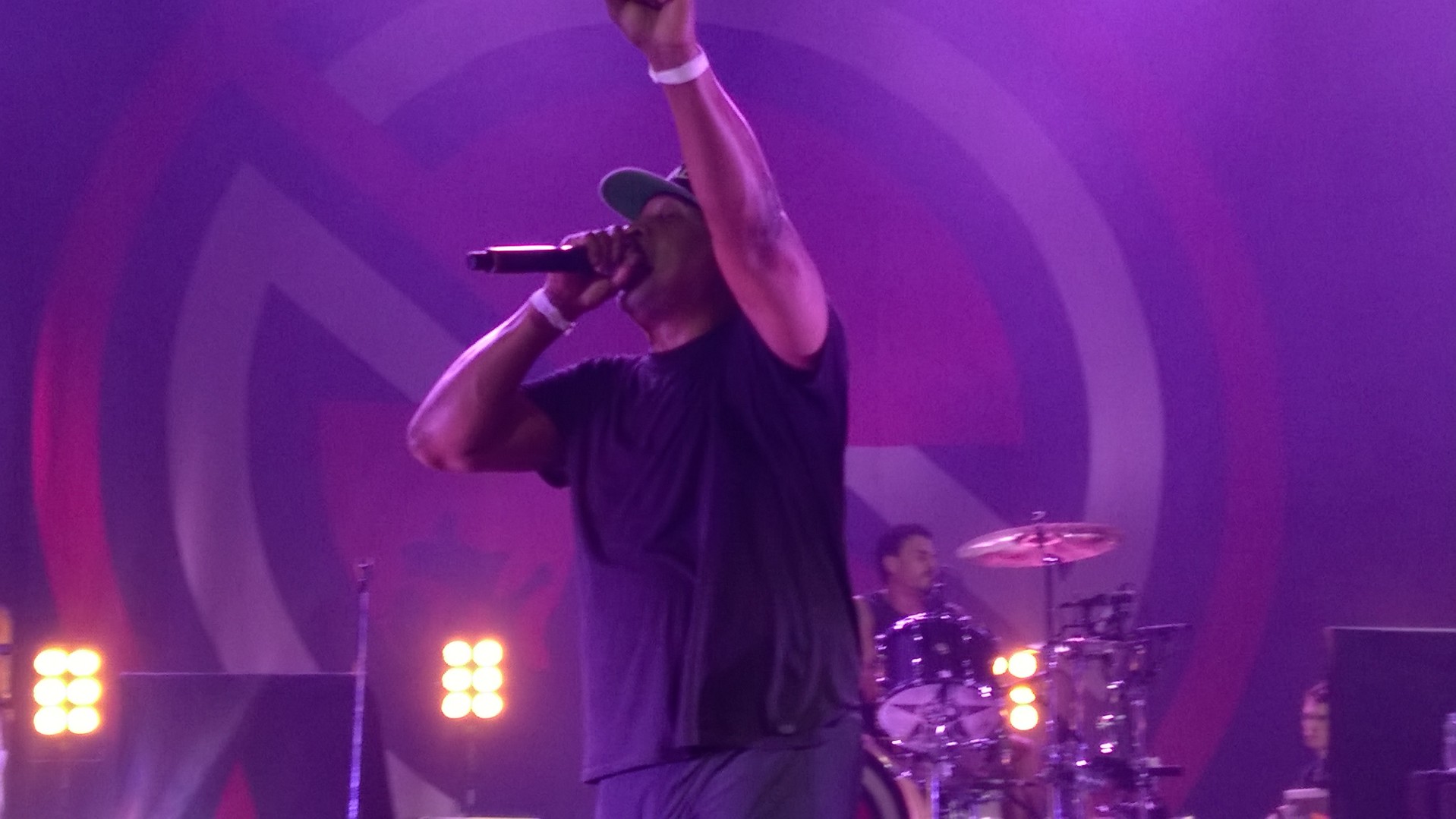
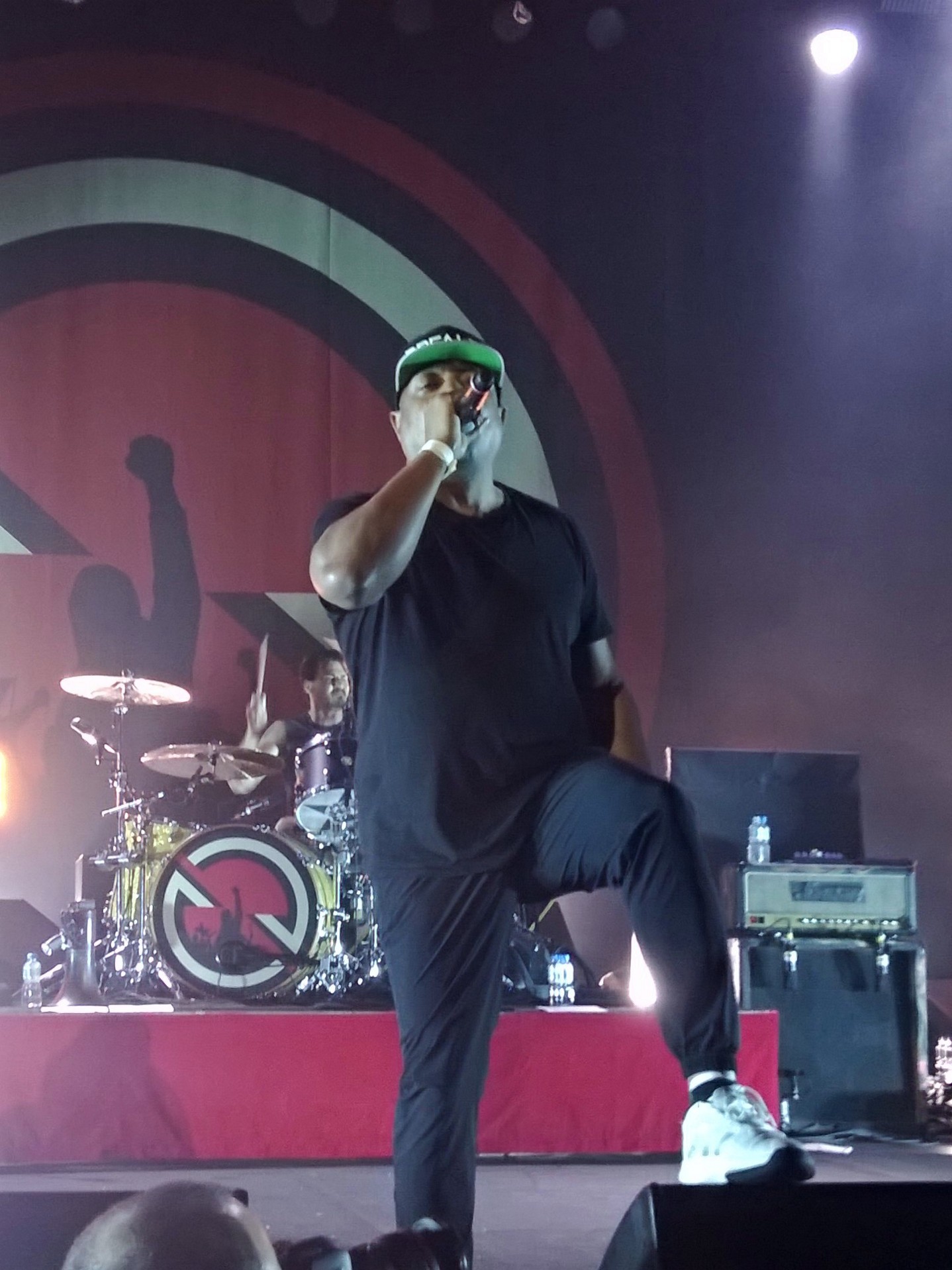
It’s getting on for a year since Prophets of Rage were first revealed to the world after months of rehearsals behind closed doors, but now this super protest group that came out swinging against Donald Trump’s election campaign has become a global entity as they take their powerful set to the four corners. Last week it was Brazil, and on Friday night (May 12th) Tom Morello, Tim Comerford and Brad Wilk of Rage Against the Machine hit the stage at Vivo Rio with vocalists B-Real (Cypress Hill) and Chuck D (Public Enemy), with DJ Lord, also of Public Enemy, spinning the wheels of steel.
Despite playing a set liberally spiced with RATM classics, this is no nostalgia gig, the dynamic of not one, but two hip hop greats on vocals giving the project an exciting edge. Throw in a handful of PE numbers, a few snatches of CH, some surprising covers and even some original material (there’s an album in the can due for a September release) and we have an exciting night on our hands.
An enthusiastic set from Rise Against was soon followed by an extended introduction from DJ Lord, featuring a mash up of classics from the worlds of rock, metal and hip-hop, with some badass mixing of ‘Enter Sandman’ and ‘Smells Like Teen Spirit’ to set the mood.
The siren rings out to signal the opening track, signature tune ‘Prophets of Rage’, and it’s obvious from the word go that this is one well drilled outfit. Chuck D, dressed all in black, and B-Real, doing his best Arab sheik impression, take centre stage and split the vocal duties, while the Rage boys add a whole new level of power to the Public Enemy classic.
The crowd needs little encouragement and is already bouncing around enthusiastically from the word go. Three RATM tracks follow in quick succession, with ‘Testify’, ‘Take The Power Back’ and ‘Guerrilla Radio’, increasing the intensity, before Cypress Hill’s ‘How I Could Just Kill a Man’. B-Real makes for a commanding presence stage front, handling a little more of the lead work (maybe his voice is better suited to the Rage material?), with Chuck seemingly happy to bounce off the rocking Cypress Hill frontman, swinging his microphone baseball style and taking the lion’s share on his own material.
We get two more Rage tracks to push the temperature even higher with the intense ‘Bombtrack’ and ‘People of the Sun’, before something of a hip-hop interlude. First up is the Enemy classic ‘Fight the Power’, the passing years have given Chuck’s voice more gravity but have done nothing to diminish his flow and the rock arrangement adds an interesting angle, the song proving a perfect fit for Tom Morello‘s idiosyncratic style.
Chuck and B-Real then make their way down to the barriers for an extended rap medley of ‘Hand on the Pump / Can’t Truss It / Insane in the Brain / Bring the Noise / I Ain’t Goin’ Out Like That / Welcome to the Terrordome and Jump Around’. To be honest, the sound is pretty rough at this point, but the two MCs are giving it their all and are rocking the crowd up close. ‘Jump Around’ is an undeniable crowd pleaser and after working its magic, one of the greatest riffs in history kicks in and ‘Sleep Now in the Fire’ opens the second half of the show, which can only be described as insane.
Pits open up all over the venue as ‘Bullet in the Head’ elicits an almost primal reaction from the energetic crowd. ‘The Party’s Over’ and ‘Know Your Enemy’ maintain the intensity as what started out as well-drilled slips into top gear and becomes high-octane.
There is something so right about the chemistry in this band that even the new songs sound like instant classics; upcoming single ‘Unfuck The World’ being greeted with the same enthusiasm as the rest of the set. The White Stipes’‘Seven Nation Army’ is then a surprising addition, before ‘Bulls on Parade’ once more whips the crowd into a frenzy.
Tim McIlrath from Rise Against takes to the stage for the now traditional ‘Kick Out the Jams’ cover and then there’s only one song left. The inevitable closing track ‘
Killing in the Name’ is quite simply one of the greatest protest songs ever and cannot fail. Tonight is no different. The crowd going absolutely mental with circular mosh pits filled with bodies crashing off each other and the floor is absolute ecstatic chaos.
There are no false pretenses here though, we aren’t getting an encore – ‘Killing in The Name’ is the end, and that’s it; what more could you possibly want?
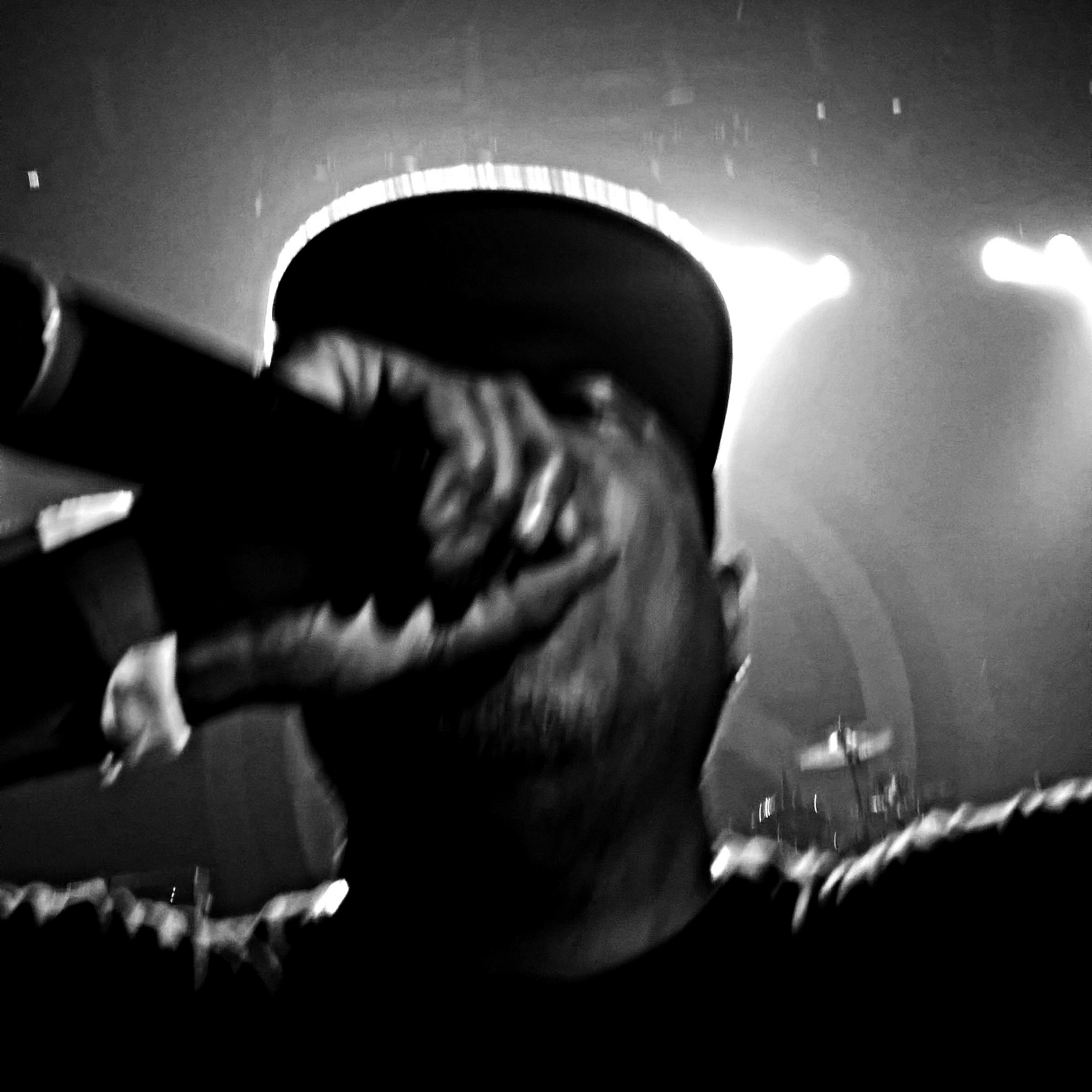
All told, it’s a pretty damn superb performance; the playing is highly professional with impeccable rhythms and Morello never dropping a note; the two MCs work the stage with such a cool dynamic it is as if they’ve been performing together for years and DJ Lord slips in and out seamlessly, even managing a battle with Morello. There is undeniable chemistry and the exchange of energy between band and audience is quite contagious, provoking the kind of scenes not seen since smart phones became the norm. Then there’s the songs – every single thing stands up – whether it’s the Rage classics, the PE classics, the Cypress Hill classics or the new material – it all works and they nail it every time.
Prophets of Rage is a supergroup named after a Public Enemy song, featuring the uncompromising rapping of Chuck D and Cypress Hill‘s B-Real, with Tom Morello, Tim Commerford and Brad Wilk of Rage Against The Machine, as well as Dj Lord of PE manning the decks. According to the band’s website “We can no longer stand on the sidelines of history. Dangerous times demand dangerous songs. It’s time to take the power back.” And that’s precisely what they deliver on this hard rocking, hard rapping collection featuring one original song ‘The Party’s Over’, and four reworkings of assorted classics.
A siren call hails the calling card opener, ‘Prophets of Rage’, which is sounding fresher than ever with Morello’s signature riffing and a new verse from B-Real, whose sharp delivery is a good foil to Chuck’s rough edged baritone. It’s a simple but effective protest song stacked with old skool references, whilst still sounding current; its slick delivery like a controlled release of pent up anger.
The band’s first original material comes with ‘The Party’s Over’, which kicks in with a signature bass heavy riff typical of RATM, and rumbles along at a slow grind as Chuck and B-Real trade verses expounding on the failure of party politics. It’s a hard hitting tune that pulls no punches and as they crank up the intensity for the furious finale it all just sounds so damn badass as everything slips perfectly into place.
It’s pretty hard to go wrong with such a superb song as ‘Killing in the Name’, and the dual vocal attack totally nails it, besides delivering a nice twist on the lyrics in the second verse with “Some of those that hold office/ are the same that burn crosses/ some of those up in congress/ are the same that burn crosses”. As the song builds to its inevitable climax of ‘Fuck You…’, the dynamic sounds like that of a band that loves playing together, they may be protesting against pretty much everything, but it sure as hell sounds good.
‘Shut ‘Em Down’ features a verse each from the Cypress Hill and PE songs of the same name and is another hard rocking slice of hip-hop. It’s easy to see how these bands always crossed over so well. Final track, ‘No Sleep Til Cleveland’, is basically the Beastie Boys’ classic mashed up with Enemy’s ‘Fight The Power and reworked for 2016. Here Morello comes into his own as he rolls out all the tricks on a mesmerizing instrumental section – first time I saw Rage he blew me away – good to hear he’s still got it. “No sleep til Brooklyn” morphs into “til Cleveland” at the end, as it was recorded at the band’s protest against the Republican National Convention in the same town. Talk about taking it to the streets!
On the whole this is a mighty fine showcase of what Prophets of Rage have to offer and is testament to the commitment the various members have to their political principles. Moreover, they sound so naturally good together that it would be great if there were more original material to come taking it beyond reinterpretations of their own impressive catalogues.
As this is one of my most viewed posts and given that Public Enemy and Chuck D have remained as relevant as ever into the 2020s, I have edited and extended the post to fit the times: That Public Enemy are The Beatles of Hip-Hop is given, that Chuck D is the Godfather likewise, but there’s always been another level with Chuck and PE. Not only have they always been a band apart from the scene, but also the one rap group capable of crossing genre boundaries, as proven on tours with The Cult, Prodigy, and, recently, Guns n Roses. It’s no surprise that despite being in their sixties and with a career of over forty years they are still raging and delivering quality work; last year’s ‘Black Sky Over The Projects: Apartment 2025’ being all killer, while the soundtrack to ‘Live from Metropolis’ proved they are still a cut above the rest on stage.
Neither Public Enemy nor Chuck D could be described as subtle, they have a point to get across and do so forcefully, the politically charged subject matter of their lyrics more suited to the direct approach. For in your face delivery of barbed social commentary and raw power, Chuck’s booming baritone is unmatchable, his distinctively resonant voice setting him out as one of the most unmistakeable MCs of our time. It´s testament to his talent and Public Enemy’s standing that outside of the band Chuck has contributed to a number of collaborations in genres as diverse as Folk and Heavy Metal, check them out below…
Cutting Heads with John Mellencamp When folk singer Mellencamp wrote a song about his irritation at rappers using the “N” word in their songs, he needed a black voice and there was really only man he could call – ” I thought coming from me alone, it would be obtuse. But Chuck is the conscience of the whole black community. He was the only choice to do this song with me, because he’s the only guy that never participated in it, always kept his integrity and his wits about him.” Bluesy folk with a southern groove and a laid back rap from Mr D.
New Agenda with Janet Jackson When Janet Jackson took full artistic control of her career and made her phenomenally successful fifth album ‘Janet’, Chuck was the man to provide a hard edged counterbalance to JJ’s pop stylings. (Not so) Surprisingly, the black-pride anthem is a fine slice of slick pop music with a little added depth – tune.
Your Reality’s a Fantasy But Your Fantasy Is Killing Me with Boom Boom Satellites The big beat jazz punk of this Japanese duo makes for interesting listening and this extremely likeable track features a stellar vocal performance from Chuck. Now though, the only version still spinning on YouTube is the Coldcut remix, which is also awesome!
Survival a.k.a. Black Survivors with Bob Marley ‘Chant Down Babylon’ is an absolutely superb remix album of Bob Marley‘s music featuring a number of contributions from the likes of Lauren Hill, Busta Rhymes and of course Chuck D. There’s a short rough and ready rap from the Public Enemy frontman as well as spoken contributions. Great album, well worth checking out.
Bring The Noise with Anthrax This is without doubt the ultimate rap metal crossover collaboration and, back then, speed metal with rapping on it was pioneering stuff – damn, even Scott Ian contributes a verse. Quality. Check out the all star on stage mosh on this version.
Prophets of Rage with B Real, Tom Morello, Brad Wilk, Tim Commerford and DJ Lord
This was actually much more than a mere collaboration, it was a full blown band project with Chuck as second MC to B Real of Cypress Hill backed by Tom, Tim and Brad of Rage Against the Machine & Audioslave, as well as DJ Lord. They made an EP and an album and toured the world. Quite frankly, they were fucking amazing and it is still one of the best shows I have ever been to – they absolutely ripped it up in Rio and I had the privilege of being front and centre and shaking Chuck’s hand. Many thanks to DJ Lord for putting me on the guest list. Here’s a taste of what it was like.
The apparent liberty and misguided feeling of anonymity afforded by the internet have led to a shift in cultural paradigms. After a few years of dial up connections and getting excited when you received an email or managed to penetrate the ads and access the monumental porn database, broadband and 3G eventually woke us up to the potential of this international network of computers and legitimized our God given right to steal music.
“But file sharing’s not stealing – it’s like making a tape of your mate’s CD” I hear you cry, and to an extent you have an argument, but when we were younger and we made tapes this was often a way to get into something new we would later acquire, not quite the same thing as torrenting the entire back catalogue of your favourite artist now is it?
By necessity our music tastes were much more tribal than today because our access was oh so limited, so we tended to stick to what we knew we liked, and tape swapping was a way of broadening horizons and getting to know different bands or genres, albeit constrained by the limitations of the format; I miss tapes. Nowadays, the entire scenario is different – we basically have access to everything and listen to everything – now it’s actually kinda cool to have guilty pleasures or varied tastes.
This wide ranging access afforded by the internet has led to the rise of streaming; and now you can stream pretty much anything from books through to porn. We are the immediate generation, transcending “On Demand” to “Right Fucking Now”; patience is no longer just a virtue, it’s a rare commodity as scarce as likeable politicians. Attention spans are equally hard to come by, so streaming is the perfect solution, if we don’t get instant gratification we can bin it and move on, no need to invest time or money in something not instantly likeable, unless of course you like a challenge. As far as music goes, on the surface at least, the enormity of the available catalogues on streaming services is proving a raging success and is the latest chapter of the ever changing story board that is the music industry, so what’s going on and why is it the future?
Streaming services first became viable as a result of governmental concessions granting certain liberties in regard to royalty payments. In a nutshell, so as to facilitate their growth, they were given the possibility of paying lower rates than radio or tv or from physical sales; so called digital performance royalties. Basically, the record companies and independent artists license out their catalogues to digital services through aggregators like Nimbit, TuneCore or CD Baby and the royalties are then collected and distributed through Sound Exchange, with artists recouping as little as half a cent per stream. i.e You’d need 20 thousand streams to make 100 bucks, which when compared to standard royalty rates of 9.1 cents essentially equates to slave labour – in no other industry would this be acceptable.
Now that streaming is so well established maybe it’s time for a rethink on this, especially now that it counts towards sales figures and chart positions. This move is probably part of a grander plan from the conglomerates, a kind of first step towards the much more lucrative mechanical royalties, as paid on physical sales and downloads. In the meantime, at least the digital platforms provide another way to discover an artist, so there is a bit of shop window factor in return for musicians not really making any meaningful cash from their music.
Right now there are a number of players offering a variety of streaming type services, from the ubiquitous “freemium” service of Spotify, through the dominant online radio of Pandora, which is also set to join the on-demand market using its powerful brand as leverage, to the totally paid services like Rhapsody or Napster. There are even ad-supported platforms like the extremely attractive Guvera, which is only available in about 20 countries, but set to expand. And lets not forget the tech giants like Apple and Google pimping their services to their already cornered markets.
As a dedicated non-Appler (I like thinking for myself), I know very little about Apple Music, though must admit to wishing I could access the Beats Radio programming, which I’m sure is illicitly available somewhere on the interweb. However, I find the whole Apple domination thing a little sinister – personally I like choice, flexibility and competition; running apple services on exclusively apple platforms is a little monopolistic for my taste.
Spotify is obviously the most universal entry point to the streaming market, with over 75 million users, about 20 million of whom pay for the service and provide 91% of the company’s revenue, the other 9% coming from the ads supporting the free service. In other words, one person pays for certain privileges so another 3 or 4 can enjoy the free service, hmmm. Their model is somewhat controversial as a result of the royalties thing, but from the customer’s point of view it’s an attractive option, whether you listen to their 30 million plus catalogue for free with limitations or subscribe and take advantage of being able to save albums and playlists to your devices – regardless of its brand. Personally, I prefer Deezer which offers a similar service, but their interface is not only much more attractive, but also way more user friendly – for instance you don’t need to save an album first to download it after, as well as navigation also being easier, with less polluted results.
Whatever service one uses, the whole concept of streaming has raised some interesting issues, besides artist royalties. Primarily, having such an enormous catalogue at your fingertips is incredible yet overwhelming. The realization that you can now listen to absolutely anything you want whenever you want is liberating to say the least – I’ve rediscovered old classics, got back into artists I’d forgotten I liked, checked out new releases, been recommended cool bands I’d never heard of and revisited stuff I have on vinyl but haven’t been able to play for years (when you have a young child spending money on decks is not a priority!), all without illegally downloading a thing. Personally I like not committing a crime to listen to music.
However, the limitlessness of it is kinda scary, having pretty much everything at the touch of a screen has made me think about whether or not I really need a record/CD/tape/digital file collection and to be honest that’s not a comfortable thought; as well as not getting decent Christmas presents it would be just plain weird – what would I play in the car? Imagine never studying the beautiful artwork on an album sleeve, or never reading an inlay again, or never holding the physical product! As (The Great) Chuck D says, streaming’s a fools paradise, you are basically renting music, which is not necessarily a bad thing, but a world without physical ownership of music is not a world in which I wish to live. The downloading generation are sure to super overvalue our record collections come the digital backlash. Also, can you really conceive of paying a monthly fee for the rest of your days? Again, limitlessness =scary!
Even so, the benefits of streaming are attractive, I love the “I haven’t heard it for ages” factor, I love having legal access to an album I’m curious about, and, as a subscriber, I love being able to save to my phone. And therein lies the rub. Here in Brazil, Deezer and Spotify are an easily accessible R$14:90 which in dollars is only $3:75 and comes in R$5 cheaper than Netflix over here; pretty good value huh? Especially when you consider that streaming services tend to cost around $10, £10 or €10 depending on where you are. Ten bucks would be a cool forty reais out here, twice the price of Brazilian Netflix.
Interesting discussion surrounding the issue from Consequence of Sound
Another interesting consequence of streaming is that when you search for an artist, although you get the most popular tracks you also get the discography organized by album. As such, if you are a subscriber and wish to save something to a device, the easiest way is to download the album, unless someone has already made the definitive playlist of course, as picking and choosing tracks is not only time consuming but impractical. Therefore, unless you’re a compulsive track skipper, chances are albums are getting listened to as complete works once again; in my view this is a positive thing.
Right now, the majority of users prefer the free services that are available, the challenge for the platforms is getting people to subscribe – Tidal, Deezer and Rhapsody have used a variety of techniques with varying degrees of success, Spotify’s model having had the best results thus far. It seems that people are still uncomfortable with paying for music – strange mentality if you really think about it – I mean you wouldn’t steal a book from a book shop would you? But then again, why pay to join a library?
The future, I believe, would be to make the subscription service more attractive, Spotify are already under artist pressure to do this, but keep the cost affordably low so as to increase the number of users. Basically, the free service, if you are listening on a PC with broadband or a Laptop on Wi-Fi is every bit as good as it is for subscribers; free users only really lose out on mobile devices, because as well as eating up their data quota they only get shuffle play, besides the annoying ads. So how about more ads and less flexibility on PCs and Laptops? How about exclusive content for subscribers? Make the free service less desirable, then with a higher subscription rate maybe royalties would be less laughable.
Whatever way you look at it and however you prefer listening to music, streaming services are here to stay and record companies see them as part of a coming golden age in the music industry. The big labels are already preparing for the possibility of ubiquitous Wi-Fi and super fast internet connections; and when I say super fast I mean beyond what you can imagine, thousands of times faster than today’s broadband speeds and instant access wherever you are. The information super highway is set to go supernova in the next few years and the labels are already working out how to make money from people being able to access music with such facility.
So, like it or not, subscription streaming is the future and, with any luck, the kind of money this is likely to generate may well be just the shot in the arm the industry needs; if, and it’s a big if, that money filters down to artist development and to the independent labels. After all, that the internet is a hotbed of creativity is a given, the indie/alternative/ punk scenes, fuelled by alternative streaming services like SoundCloud and artist friendly hubs like Bandcamp is thriving and is an enormous market in itself. However, too much talent falls by the wayside, as sustaining an upcoming band is quite simply not a financially viable proposition under current circumstances, but with greater investment at grass roots levels and more exciting young talent breaking through, maybe something like a Guns n Roses reunion won’t seem like such an exciting idea.
Back in 2014 a handful of lucky fans had the privilege of witnessing a one off show from rap legends Public Enemy, backed by a full live band, S1W, in the intimate setting of West London’s Metropolis Studios, in the very room where Amy Winehouse recorded Back to Black. Tickets were trading for somewhere in the region of $7000 for this exclusive gig and based on this 1h20m soundtrack to the DVD/Blu Ray, it was money very well spent. To put it simply, Public Enemy absolutely kill it.
We are treated to a selection of career spanning tracks from ‘Miuzi Weighs a Ton’, through ‘911 is a Joke’ and “Bring the Noise’ to the surprise hit from the London Paralympics ‘Harder than you Think’; they are all here, barring one or two personal favorites from Muse Sick, so it’s essentially a ‘Best of’ played live in this awe inspiring performance.
Twenty-eight years into their career at the time of recording; “He’s 55, I’m 54, that’s a hundred an’ nine fuckin years”; and Public Enemy are still at the top of their game. Chuck D’s flow is as sharp as ever, his baritone bite on every syllable the perfect foil to the insouciant style of partner in crime Flavor Flav. Not that Flav is found slacking, on the contrary, he works the crowd tirelessly and is a superb counterpoint to Chuck’s relentless attack. There is an almost telepathic understanding between the two, born of nigh on thirty years prowling the stage together, which reflects in their interplay; Flav conducting the small crowd like an excited pied piper while Chuck challenges them to keep pace. It’s a lesson to any performer in how to work a room, whatever its size; there’s only 125 people watching the show but PE are blowing the roof off.
Public Enemy may be old school but everything sounds as fresh as the day it was pressed, hitting the spot time and again. ‘Rebel Without a Pause’ is the first to really get things rocking, with DJ Lord scratching some serious vinyl, before Flavor turns up the heat on ‘911’ and Chuck piles on the pressure on ‘Terrordome’ – you can almost feel the room heaving through the speakers. S1W add a whole new depth and flexibility to PE’s sound, with some serious shredding on ‘Hoovermusic’ and ‘Black Steel’; the house is rocking and the show has barely started. “Real Hip Hop is here!”
Bring the Noise nails it, the rapping urgent and on point. There’s a funky bounce to the vibe on ‘Don’t Believe the Hype’ as Chuck and Flav work it; is that Liam Gallagher in the house? The temperature just keeps on rising as ‘Can’t Truss It’ struts out to some badass beats. Chuck D described ‘Man Plans, God Laughs’ as the most intense Public Enemy record of the century, sorry Mr D but you were way off, Metropolis is destroying it dude. ‘Fight the Power’ actually provides a slight breather after Chuck nails Bring the Noise a’capella. Flav brings it on again for 31 flavours before Shut em Down and the stunning climax that is the uplifting ‘Harder than you Think’, Public Enemy’s biggest UK hit; the horns actually give me goosebumps before some badass guitar rocks the midsection. Chuck D and Flavor Flav then bring the show to an intense close, “Just like that”.
The truly remarkable thing about this record is that the intensity and vibe of the performance comes through loud and clear; it’s rare for a live album to live up to the memory of a great show, but here you have the finest possible document of the Public Enemy live experience imaginable.
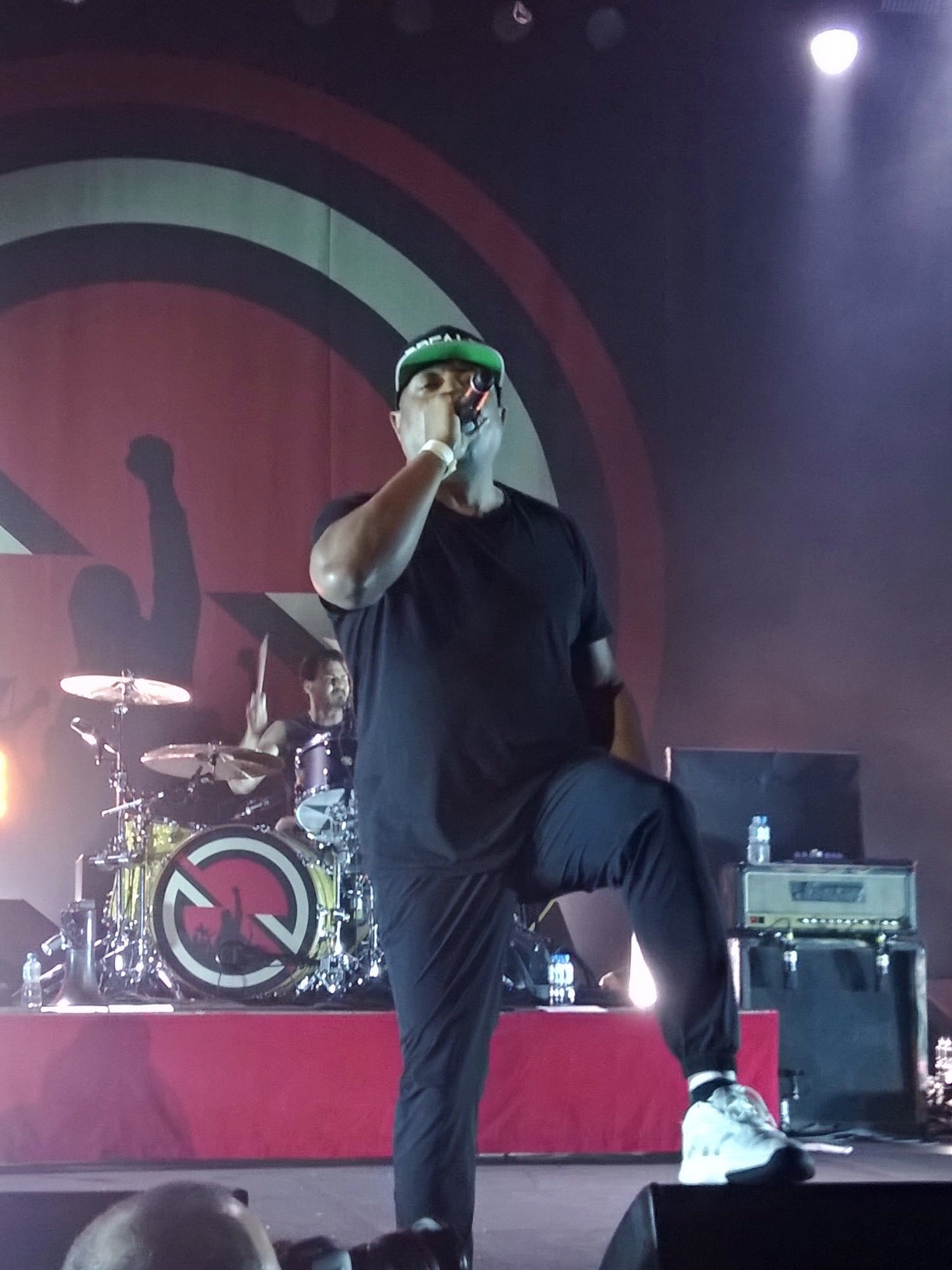 It’s getting on for a year since Prophets of Rage were first revealed to the world after months of rehearsals behind closed doors, but now this super protest group that came out swinging against Donald Trump’s election campaign has become a global entity as they take their powerful set to the four corners. Last week it was Brazil, and on Friday night (May 12th) Tom Morello, Tim Comerford and Brad Wilk of Rage Against the Machine hit the stage at Vivo Rio with vocalists B-Real (Cypress Hill) and Chuck D (Public Enemy), with DJ Lord, also of Public Enemy, spinning the wheels of steel.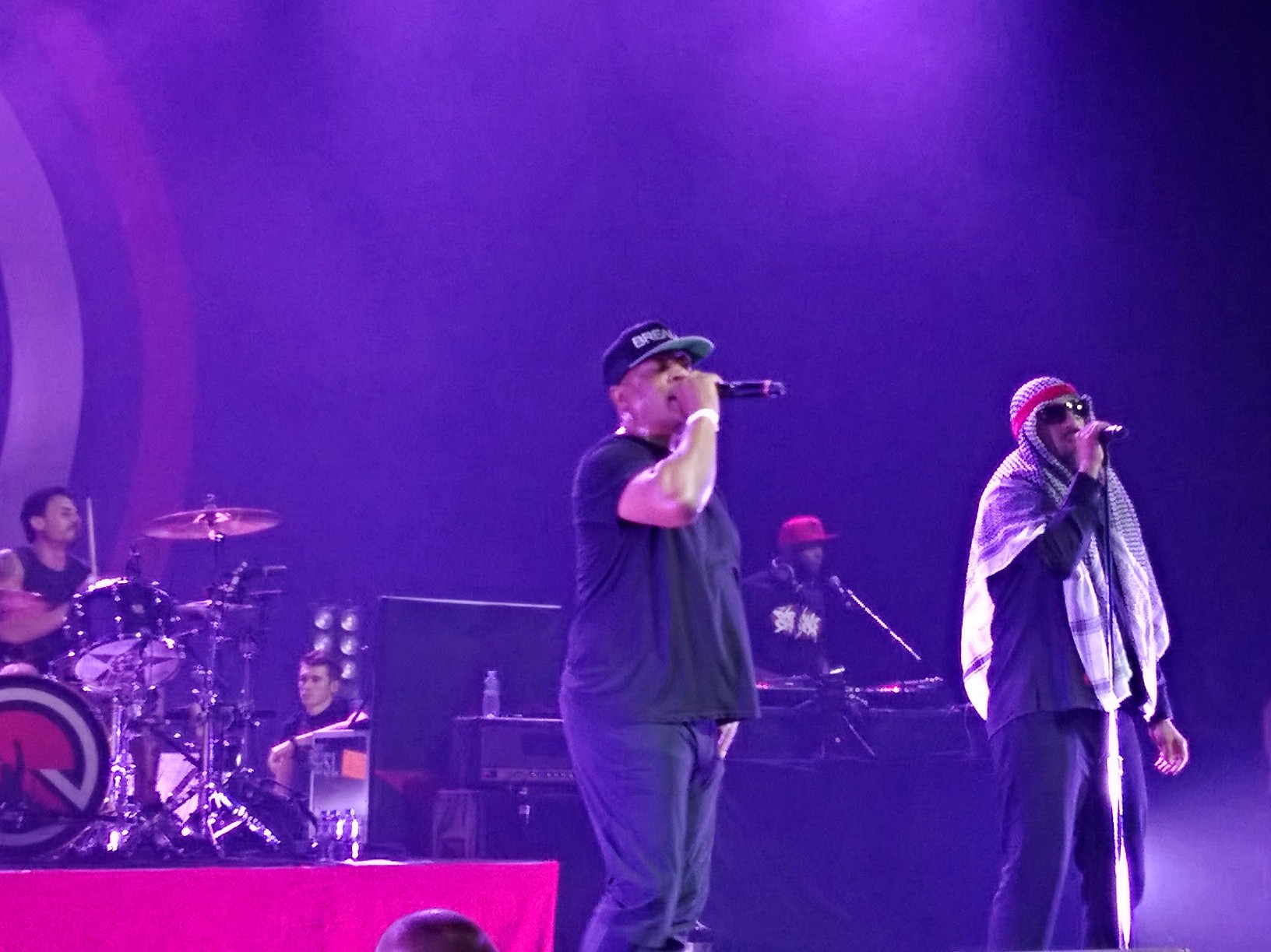
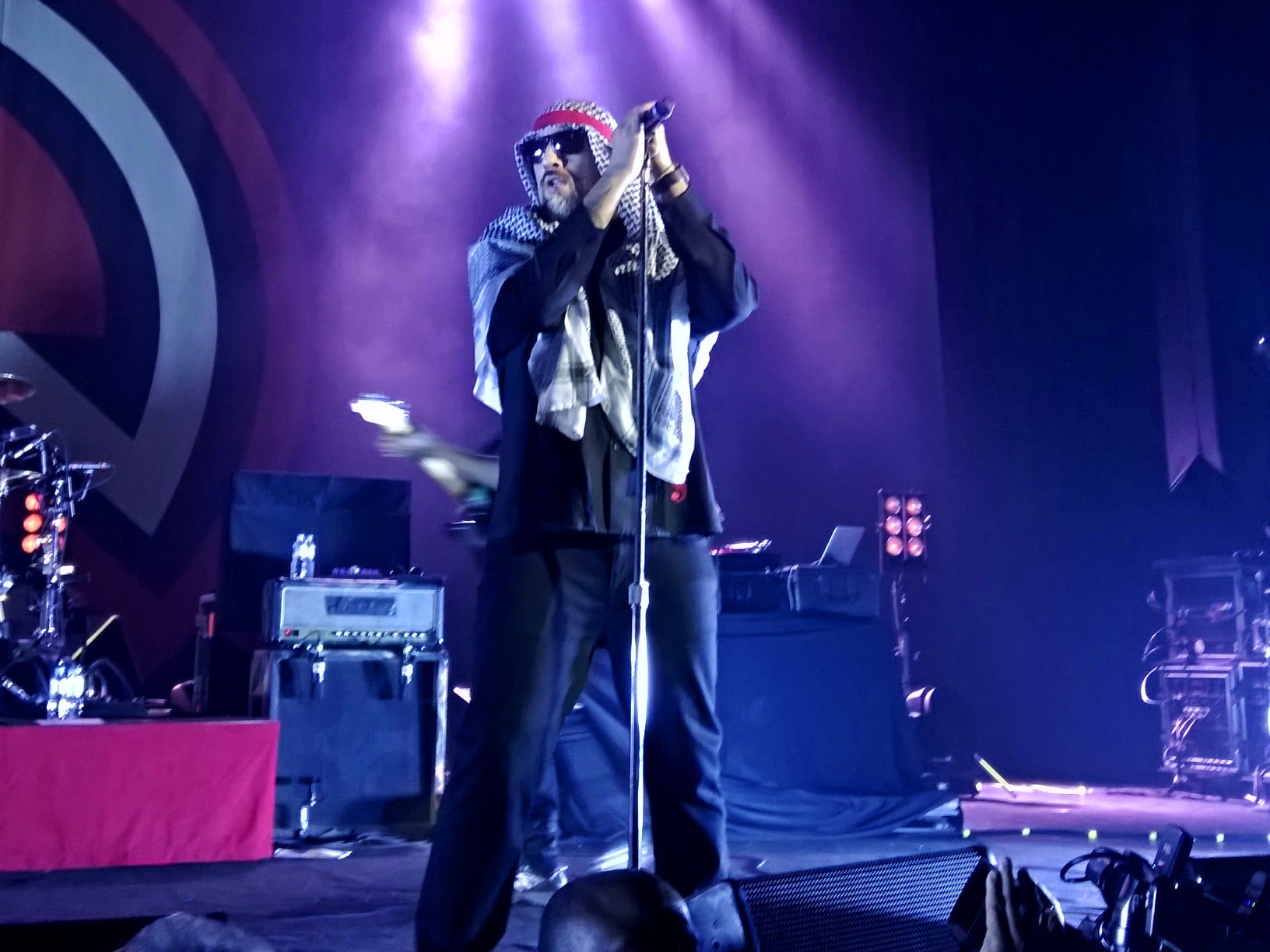
 All told, it’s a pretty damn superb performance; the playing is highly professional with impeccable rhythms and Morello never dropping a note; the two MCs work the stage with such a cool dynamic it is as if they’ve been performing together for years and DJ Lord slips in and out seamlessly, even managing a battle with Morello. There is undeniable chemistry and the exchange of energy between band and audience is quite contagious, provoking the kind of scenes not seen since smart phones became the norm. Then there’s the songs – every single thing stands up – whether it’s the Rage classics, the PE classics, the Cypress Hill classics or the new material – it all works and they nail it every time.


 Hard Pressed