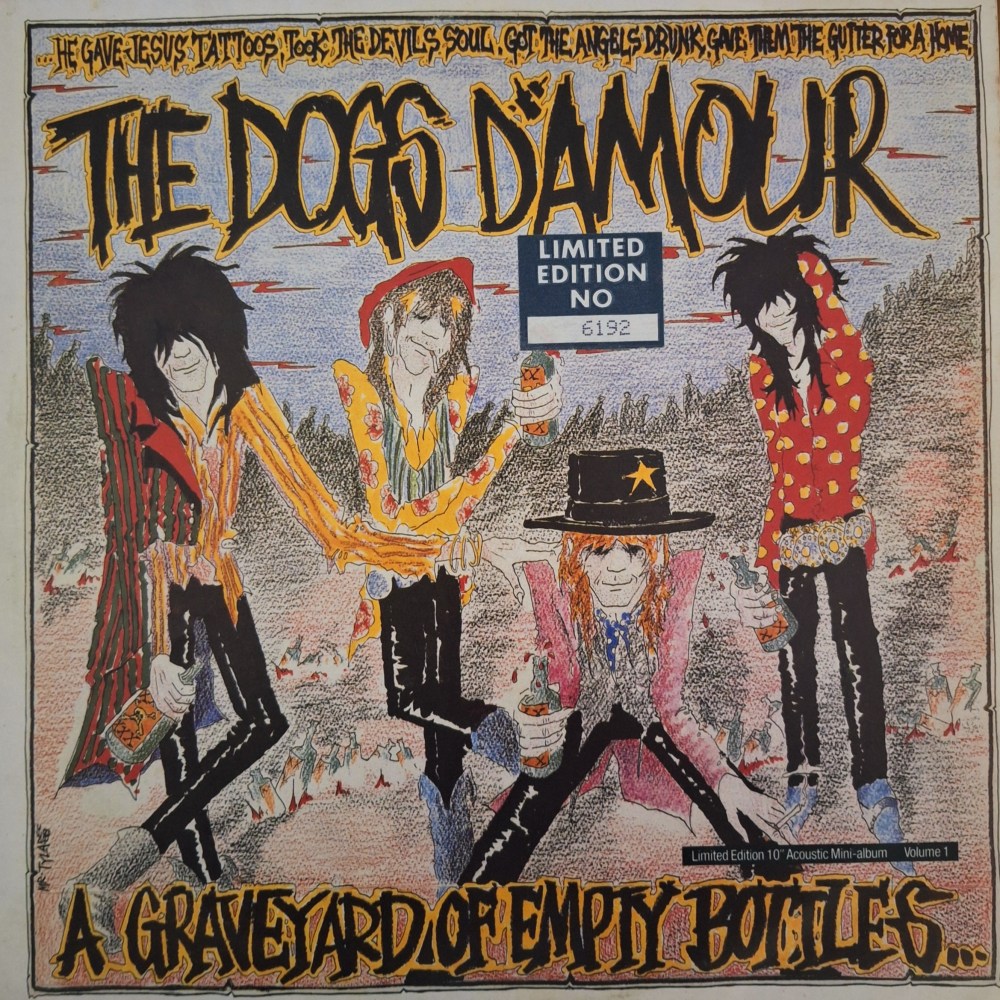
With tales of love and loss, maverick heroes and loveable rogues, The Dogs D’Amour‘s mini album A Graveyard of Empty Bottles was one of the most delightful surprise releases I’ve ever encountered. Sandwiched between the Dynamite Jet Saloon and Errol Flynn albums, it came just over a month after the superb How Come It Never Rains had flirted with breaking the top forty. It would prove to be the premature peak of the band’s success and showcases their songwriting at it’s finest.
MTV Unplugged was still some eight months away and, although Guns N RosesLies had set a precedent, acoustic albums/versions were not yet in vogue when the Dogs unexpectedly dropped Graveyard with an initial run of fifteen thousand limited edition, numbered 10-inch mini albums. It would go on to get a 12″, CD, and cassette release, propelling it to the dizzy heights of number 16 on the UK albums chart, but none would have the charm of the 10″. It’s a beautiful little package dominated by Tyla‘s artwork that so perfectly encapsulates the band’s aesthetic. The best thing about it though, was the songs themselves.
A Graveyard of Empty Bottles kicks off in upbeat fashion with the laid back, blues tinged, foot-tapping vibe of the jaunty I Think It’s Love Again, before the stark contrast of the bleak minor chords of So Once Was I, which doubles down on Tyla’s romantic view of modern day cowboys and wasteland heroes. There is more contrast as we segue into the blues shuffle of Comfort of the Devil, which finds the frontman at his most poetically sublime: “The devil runs his fingers down the spine of fate / Grins at me with a smile that spells out hate / Spins his chamber of his gun / There’s only one soul loaded for fun / Much more fun.”
But it is on Saviour, which closes out side one, or the Blue Blooded Bar Side, where the planets really align. It is two glorious minutes of the Dogs D’Amour at their very best as a heartbroken acoustic backdrop underpins a bittersweet tale of dereliction tinged with hope. In my humble opinion, this is where Tyla just about peaked as an artist, both poetically – “Let me lay your soul to rest / Let my lips drip red wine on your breast / Let me stain your pain with disinterest / Just let me be there for the rest” – and vocally as his voice soars on the killer hook, making this delicate pull on the heart strings nothing short of irresistable.
The flip side, or the 5th of Whiskey Side, opens with the original version of the title track of the then forthcoming album, Errol Flynn. Despite being a catchy, upbeat, mid-tempo romp it adds little to the record as a whole, serving more as a contrast to the heartbroken melancholy of what is to come. And come it does in the measured, atmospheric tale of disgrace that is the drunken downfall of the preacher stumbling from his castle of sin in The Bullet Proof Poet, before the understated When the Dream Has Gone brilliantly continues the story of the heartbroken lovers in How Come It Never Rains with surprising delicacy.
Once again, they save the best ’til last though. Angel initially sounds like a continuation of the previous track given the similar vocal melody, but it soon takes on a life of its own. Weighing in at a positively hefty 3 minutes 19 seconds it tells a serious of near misses for the self destructive, deftly covering loss, depression and grief in one fell swoop. The verses are as ponderous and full of heartache as the other ballads, yet the chorus soars with an absolutely sublime hook before they throw off all previous restraint in an electrified finale of blistering guitars – perfection!
A Graveyard of Empty Bottles may be short at around 19 minutes in total, but it is a delightful little collection that inadvertently showcases a much-loved band at their very best. It captures everything that was great about Tyla J Pallas and his Dogs D’Amour, from their romantic, booze-fueled melancholy to their raunchy, blues-soaked balladeering. This is unpretentious, good old fashioned acoustic rock n roll and deserves twenty minutes of your time.
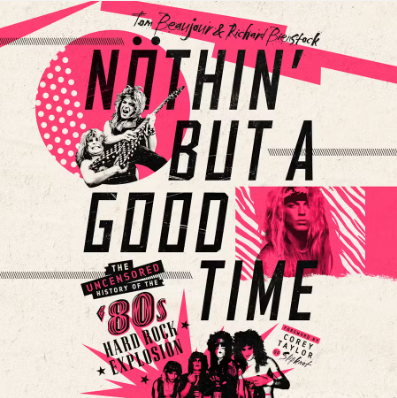
Tom Beaujour and Richard Bienstock’s Nothin’ But a Good Time tracks the decadent rise and fall of the much derided 80s hard rock / hair metal scene. It weaves a narrative from Van Halen and early incarnations of Quiet Riot, through the dizzying success of Mötley Crüe and Poison and the birth of Guns N’ Roses, to the scene’s implosion with all the look-alike sound alikes power ballading their way onto Dial MTV.
After a revealing introduction from Slipknot’s Corey Taylor (!) professing his love for the 80s glam scene, music journalists Beaujour and Bienstock create an oral history through old and new interviews and quotes from a broad selection of players from L.A. and beyond. It’s the words of those involved that paint a vivid picture of the scene and its shenanigans, whether it’s A&R wizards like Tom Zutaut, producers like Tom Werner, the bands themselves, the publicists, stylists or even the odd groupie spilling the tea.
It was clearly a wild time marked by rampant misogyny and unbridled excess, and the book takes us behind the scenes into the rivalries and ridiculousness to reveal the last hurrah of a tribal music scene before grunge changed the mood, the internet permanently altered life as we know it, and phones replaced lighters. Love it or hate it, there is no denying that it was hard rock’s most vibrant period, and, despite the scene eventually disappearing up it’s own backside and having its coffin nailed shut by the Seattle bands, it produced a lot of surprisingly enjoyable, good, old-fashioned rock n roll, as well as a bunch of stuff that’s probably best forgotten.
The book reveals all kinds of insights, from Slash’s audition for Poison to Sebastian Bach’s performance alongside Zakk Wylde at a wedding that led to him getting the Skid Row gig, via Jon Bon Jovi’s parents of course! There are all kinds of interesting backstories, but the one big shocker is that some of these bands worked really hard to achieve what they did, living in abject poverty and dedicating absolutely every waking hour to making it big.
The book can come across as a little he-said-she-said gossipy at times, but that’s hardly surprising given the overriding High School Musical vibe of the scene. Still, for those who grew up with an HR/HM soundtrack, this book provides a delightful romp down memory lane in a no-holds-barred exposé of the misadventures of the time. It has also been distilled down into a three part docuseries on Paramount+ that is equally good fun, featuring said interviews from a number of the key players.
Now that there is some distance from the time, it is clear that despite eventually becoming a parody of itself, a lot of great songs came out of the melee. So, check out the Spotify playlist that I’ve curated to more or less chronologically reflect the book’s narrative.
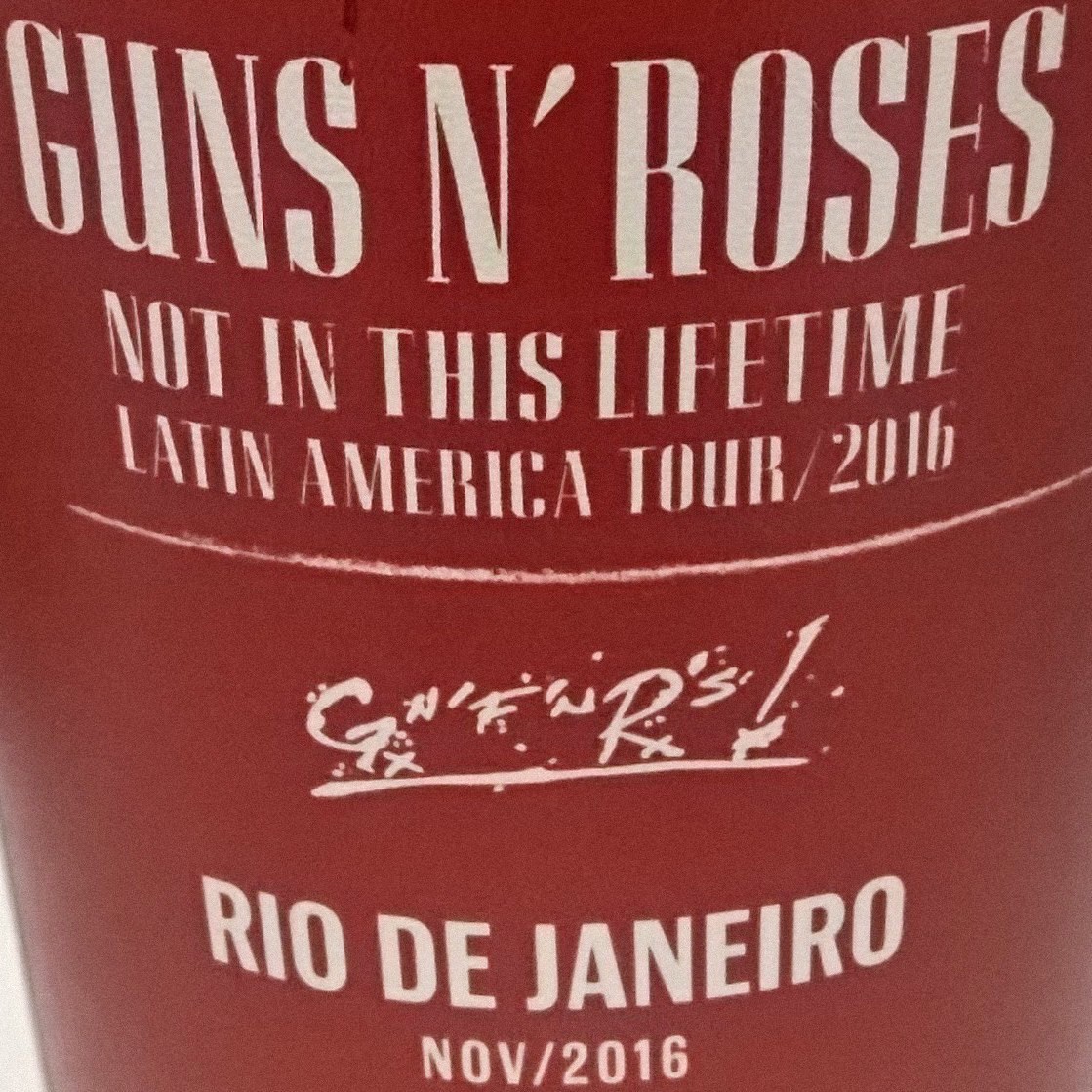
It’s been a busy old month, what with listening to pretty much everything Metallica have ever recorded for a piece I wrote for Already Heard. Then there was the surprisingly awesome, but shamelessly nostalgic, Guns n Roses show, which meant catching up on some old favourites, plus the usual selection of stuff to review and fill the hours of endless bus journeys. Also, with the usual round of end of year lists coming up, I’ve been dedicating a bit of time to checking out some stuff I’d been meaning to listen to. As such, it’s been a metal heavy month, even so, between the big ass riffs and raging solos I have managed to squeeze in some sublime listening. Here’s the smooth grooves that have been dripping honey into my brain of late.
Although It’s been out a while, only now have I got round to checking out ‘Love & Hate’ the absolutely incredible second album from Michael Kiwanuka. Damn, this is a fine record. Beautiful, heartbreaking, emotional and uplifting in equal measure. It makes for a superb take on human nature, echoing with vibes from the sixties and seventies, yet succeeding in sounding contemporary and topical, this is a sublime record that will be very close to the top of my end of year lists.
The cool groove of Warpaint‘s Heads Up has also been on pretty heavy rotation of late. There’s something wonderfully understated about the subtle mix of textures on these laid back deep cuts that keeps me coming back for more. There is a lot of experimentation with beats to compliment the hypnotic qualities of the vocals and instrumentation, all of which kinda defies classification and gives it a refreshing air of individuality. It’s well worth giving this a few plays and immersing yourself in its subtleties.
Another cracking recent release that I had the pleasure of reviewing, is the totally old school thrash of Testament and ‘Brotherhood of the Snake’. Honestly, this is as good as, if not better than, anything they released back in their heyday. It’s by far their most frantically thrashy record and includes some serious hooks that make it instantly catchy. Chuck Billy delivers an absolutely killer vocal performance throughout on track upon track of raging metal. Killer record.
So, a few months back I wrote a piece on the much lauded Guns n Roses“reunion”, saying what an awful idea it was. My argument was basically that it was a cynical money making venture and that Axl could not and would not cut it, as he has been largely shit for the last 20 years. I also suggested that the shows would be nowhere near as good as they were back in the day and that it was one more nostalgic nail in the coffin of modern rock.
However.
Then I saw the videos of the performances from the U.S and it was pretty damn obvious that Axl was actually cutting it. Maybe not like a hot knife through butter, but there were high notes and enthusiasm, and not just in GnR, but in AC/DC too. And with a broken foot.
Then, as the tour showed little sign of imploding and actually decided to roll on down to South America, what else could I do, but see for myself.
So the question is, did I eat my words?
Kinda.
After a functional set from the uninspired choice of opening act, Brazilian rockers Plebe Rude, and a surprisingly short interval, in which we got to see the really quite beautiful logo variations on the backdrop, the Looney Tunes theme blared out and it was showtime.
‘It’s So Easy’ kicked things off and we all went mental. Seriously. Once upon a time Guns n Roses was known as the most dangerous band in the world and for the first 15 minutes or so it was easy to see why. The crowd was like a raging sea as it bounced as one to the punk energy of the opener and the swagger of ‘Mr. Brownstone’, even ‘Chinese Democracy’ got people jumping before the teased intro to ‘Welcome to the Jungle’ eventually sent everyone ballistic. For a few moments Axl, Slash, Duff and Co rocked as hard as they ever did; sure they are a little slower and a little rounder, but they still know how to deliver a good old fashioned hard rock banger.
‘Double Talkin’ Jive’ immediately calmed things down a little and calm they stayed, for the underrated ‘Better’ and an absolutely epic performance of ‘Estranged’. Despite proving spectacular and one of the highlights of the night, this was the first of many rather indulgent mega ballads – we got them all, bar ‘Patience’.
‘Live and Let Die’ was predictably frantic, prior to the cool bass groove of the sorely underrated ‘Rocket Queen’; the already lengthy track gaining an extended midsection and sexy skeletons on the backdrop. There was another surprise in ‘Out Ta Get Me’ before the heroin chic of the tireless Duff McKagan pounded out the bass riff to ‘You Could Be Mine’ to get the crowd bouncing again. Although Axl was mostly excellent, reaching most of the high notes, it was here and more notably on ‘Coma’ that he struggled – the fast sections tripping him up a little. A mid set breather was due – cue Duff and his version of the Misfits‘ ‘Attitude’.
‘This I Love’ preceded the epics ‘Civil War’ and ‘Coma’ before the obligatory Slash solo of Speak Softly Love (Love Theme From The Godfather). It was all great stuff and the top hatted one still shreds, but the dude has been playing the same damn thing since I was a kid – talk about playing it safe. Was it then necessary to do an instrumental duet with Richard Fortus on ‘Wish You Were Here’? Sure, it was awesome, the crowd sung it, people cried and Slash and Richard nailed it, but two solo slots?
Sandwiched in between were the unbeatable ‘Sweet Child O’ Mine’ and the surprisingly fun ‘Yesterdays’, which proved much more enjoyable in the live arena than on record. In a neat twist they then segued ‘Wish You Were Here’ into the piano outro from ‘Layla’ to get Axl on the piano.
Only one song could follow, and follow it did. On the one hand November Rain epitomizes everything that is pretentious and overblown about GnR and can so easily turn into an awful lumbering spectacle of over indulgence. Thankfully though, the front man seems to be in a good place right now, despite him and Slash virtually ignoring each other all night, and he crooned his way though with technique and urgency, delivering one of the best vocals of the night. For some reason most of the crowd seemed to have balloons to go with cell phones and it all made for a quite beautiful spectacle, even more so as the massive full moon emerged above the stadium right on cue – I guess these kind of shared moments are the whole point of such nostalgic outings. Fair play Axl.
Two hours in and the vocalist was visibly enjoying himself as he rolled back the years to dart around the stage to conduct the crowd in a sing off on ‘Knockin’ on Heaven’s Door’. By now it was utterly shameless enjoyment of timeless classics, and we were certainly getting our money’s worth.
We rocked again for set closer ‘Nightrain’, but it was back to the ballads in the encore of ‘Don’t Cry’ with more extended guitar work. The Who‘s ‘The Seeker’ offered an irresistibly big riff, but we were really only waiting for ‘Paradise City’ to rock to an explosive close. And it did not disappoint – mosh pits opened up, swathes of bodies bounced as one and it was genuinely wild abandon in the crush – it almost felt like 1990 again.
The crowd actually demanded another encore, but the band returned merely to take a bow, all hugs and smiles.
So, all in all, I guess you have to take your hat off to Guns n Roses – they are still a mighty proposition and deliver a fine performance. They are seasoned pros and know how to work a stage and get a crowd going, despite the minimal interaction between band members and between band and crowd.
Are they still dangerous? Not really, but they do rock and they are a pretty tight unit; they put on a show but it’s not over produced and works well with less people on stage – no horns, no backing singers, a cool backdrop of images and minimal pyrotechnics keeps it lean.
Is Axl the vocalist he was 25 years ago? He’s a damn sight closer to it now than he has been in the last 15 years. His range is impressive and he works the mic, but the impression is that age has taken it’s toll a little and slowed up the delivery, there may be an element of tiredness too.
Are they just in it for the money? Surely that is a factor, but then again they do seem to be enjoying themselves, so I’ll reserve judgement. Also, they may be raking in the cash, but at two and a half hours long their set is pretty damn good value.
Is it all just shameless nostalgia? Sure, of course, but when you are this good and the material still cuts it, then why the hell not? Quite how long the night train can roll on without new product though is open to question, as is whether or not the relationships will endure. In the meantime though, they are well worth the trip down memory lane.
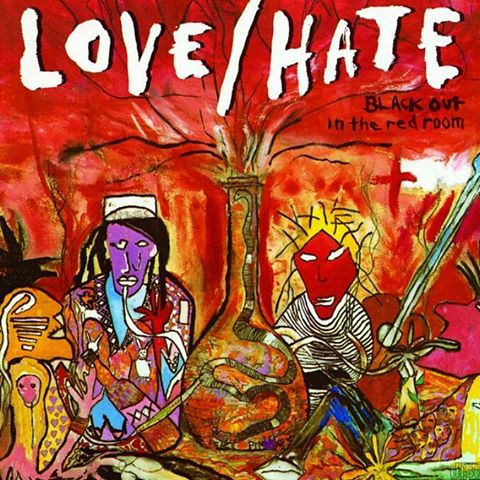
Back in the late eighties hard rock was fast disappearing up its own rectum; the proliferation of hair metal bands had reached epidemic proportions and each and every one of them was following the same formula of massive choruses, massive heels and at least one massive power ballad. Quality hard rock was hard to come by, except, of course, in the form of Guns n Roses, who totally dominated the HR/HM scene, and to a lesser extent Skid Row, who were somewhat unfairly lumped in with the sunset strip wannabes, when in fact they were substantially heavier and had a lot more going on in the songwriting department, especially on ‘Slave To The Grind’. Anyway, in the midst of all this a band that had been struggling to be heard and get a record deal finally got signed and delivered a quality slice of hard rocking, Jack soaked tunes with barely an eye liner in sight.
In simple terms ‘Blackout In The Red Room’ rocks, and hard. The refreshing thing about the album was that it wasn’t just copying GnR, it wasn’t just following the formula of all the hair bands and although there are a few clichés, it wasn’t all high hats, cow bells and radio friendly harmonies. Instead, what you get is a bunch of dirty sounding riffs, abrasive vocals and some coolly arranged tracks largely about getting wasted. Oh yeah, and no power ballad.
The title track sets the pace with a mid tempo swagger and some serious groove; it may be a true headbanger, but in rock clubs it was a surefire floor filler. ‘Rock Queen’ is a stylish second track featuring a stack of hooks and the wonderfully bizarre line of “Let me touch your cookies/Let me eat your cookies”!
The album continues in a flurry of hard riffs and well worked tunes, with highlights like ‘Fuel to Run’ and ‘Tumbleweed, which are good hard rockers and the frantic old school finale ‘Hell, Ca., Pop.4’. Although ‘She’s an Angel’ borrows heavily from the book of hard rock clichés for its more serious tone, it is as quality a slice of metal lite as you’re likely to hear.
Ok, so one track or another doesn’t exactly set the world on fire, i.e ‘Slutsy Tipsy’ and ‘Slave Girl’, but in general the standard is high. For example, the ode to weed that is ‘Mary Jane’ is a nicely arranged number with some cool twists to the tempo and more great guitar work. The standout track though, is the song which got heavy rotation on MTV, ‘Why Do You Think They Call It Dope, a killer tune with a great hook and some funky assed bass.
On the whole ‘Blackout…’ stands up as a damn good record that was a cut above a lot of what was coming out of sunset strip at the time. They may not have been PC or had the general appeal of a GnR or a Skid Row, but there was some serious talent in the band and some hard rocking bangers on this record. If dirty riffs, blazing solos and raspy vocals are your thing, it’s well worth revisiting.
There are very few bands left in the world for which the release of a new record would be an event, and lets face it, outside of the reformed Guns n Roses dropping ‘Appetite…Part 2’, the biggest possible such event is new music from Metallica. The San Francisco metallers once thrashed out 4 albums in five years, so having waited 8 years since ‘Death Magnetic’, a new album is long overdue, but finally, come November, the 12 track double album will hit the racks. In the meantime, we have the video for album opener ‘Hardwired’, which they dropped yesterday, August 18th, three months ahead of the album. The question is though, is it any damn good?
The short answer is yes, of course! It’s fucking Metallica, even their worst music is streets ahead of the majority, the bigger issue though, is whether it will stand up alongside ‘Master of Puppets’ and the uber popular Black album, which is precisely what it sound as if they are aiming for. The production has that clean crisp resonance of Death Magnetic, not surprising given Greg Fidelman is once again fiddling with the knobs, but there is more than an echo of ‘Battery’ to Lars’ furious drumming and Kirk’s blistering soloing. There’s also a definite air of the early 90s about the black and white claustrophobic video for the track.
The song actually begins with machine gun riffing/beats and a staccato riff á la ‘Enter Sandman’, before the real thrash gallop begins. It features all those little stops, time changes and familiar elements of the signature Metallica sound, although James wasn’t exactly up all night on the hook – “We’re so fucked!/ Shit outta luck”. He does make amends in the ‘Whiplash’ style third verse however – “Once upon a planet burning/ Once upon a flame/ Once upon a spirit turning all in vain/ Do you feel that hopeless feeling?/ Do you comprehend?/ Do you feel it terminating in the end?”. It all sounds somewhat familiar, but hey, I guess that’s kinda cool, we want Metallica to sound like Metallica!
After repeated listens, I’ve gotta admit that it pretty much hits the spot – one foot in the past, one in the present – ok, so it may lack the rawness of ‘Ride The Lightning’ or ‘Master of Puppets’, but this is brand Metallica launching new product, so there’s no way it will ever be that amazing again. However, considering that it’s now thirty something years down the line and the band are in their fifties, it’s good to know that like the rest of the big four, they can still shred. See for yourself right here:
I recently wrote a massive kind of introduction to Iron Maiden piece for http://www.alreadyheard.com, but due to editorial constraints I had to cut it down and change the format and stuff. However, having put rather a lot of time and energy into its researching and writing, I’ve decided to make the most of it to reproduce a brief history right here.
Iron Maiden was born on Christmas day 1975, but spent three years messing around with different members, before Steve Harris, Dave Murray and their then colleagues got it together to record a demo on New Year’s Eve 1978. Such was the popularity of the demo, that in under a year it had been pressed and released under the name of ‘The Soundhouse Tapes’, all 5000 copies selling out in a few short weeks based on word of mouth; had secured them a manager in the rotund form of Rod Smallwood; oh yeah, and landed them a major label record deal with E.M.I..
By April of 1980, riding high on the New Wave Of British Heavy Metal, the Londoners were already delivering the goods – their eponymous debut crashing the UK album charts at number 4. Featuring Paul Di’Anno‘s rough edged vocals, it boasts a raw energy honed to perfection by five long years on the East London pub circuit. From the sinister rock riffing that opens the murderous ‘Prowler’ there is something quite daring about it; this is the sound of a band exploring its creativity, pushing themselves and the Heavy Metal genre forward, reworking classic ideas whilst incorporating new. The most startling example of their innovation is the monumental ‘Phantom of the Opera’, an epic master class in songwriting that helps make ‘Iron Maiden’ one of the finest debuts in Heavy Metal. In one fell swoop, Iron Maiden established themselves as the act to follow, not only in sound, but also in marketing, the stunning first glimpse of Eddie The Head the first step to establishing their merchandise empire.
However, Harris and Murray were still having difficulties with personnel, which led to Adrian Smith joining the band prior to the recording and release of 1981’s ‘Killers’. Although it was another quality album, there was little to set it apart from their debut, it largely consisting of left over material, plus there were more personnel problems on the horizon. Besides the excessive drug use of vocalist Paul Di’Anno, which never really fit the band’s profile, the raspiness that had initially attracted Harris to his voice would prove to be the singer’s downfall; his hard rock tropes were just too limited for the direction the songwriting would take.
Samson‘s Bruce Dickinson was seen as the perfect replacement and slipped seamlessly into the band for the recording of ‘The Number of the Beast’, the album that changed everything, providing their first UK number one. ‘Beast’ is jam packed with killer material, the songs are quite simply in a different class, whether it’s the riff fest that is ’22 Acacia Avenue’, the hook filled chorus of ‘Run to the Hills’ or the subtle complexities to the epic tale of ‘Hallowed Be Thy Name’, which is arguably the band’s finest moment in itself, the songs are quite simply in a different class. It is a genuine classic that created a template by which future Metal albums would be judged. With Nicko McBrain replacing drummer Clive Burr after the supporting tour, what would become the classic line up was in place and the Maiden machine would march on to conquer the world.
The first half of the 1980s was the band’s most prolific period and would see them produce a quite staggering album a year for five years until 1984, followed by the definitive heavy metal live album in 1985’s ‘Live After Death’. Simply put, it is one of the finest live albums ever recorded and documents the seemingly endless World Slavery Tour following 1984’s ‘Powerslave’ and the 1983 album that first broke them stateside, ‘Piece of Mind’. The tour went on so long that Dickinson actually threatened to quit if they didn’t have a few months off.
The break was short lived however, as they were soon back in the studio for ‘Somewhere In Time’, on which they controversially added some synthesised elements to their signature sound; something they further explored on 1988’s conceptual affair ‘Seventh Son of a Seventh Son’. Even so, both albums were warmly received by critics and fans alike; the latter providing the band with their second UK number one. The supporting tour culminated in their first headline performance at Donington for the Monsters of Rock festival, which was marred by the death of two fans in the crush during Guns n Roses’ UK debut set.
Chinks were starting to appear in Iron Maiden‘s armour though, Dickinson was feeling creatively limited by the band’s sound and released his first solo album, the vibrant ‘Tattooed Millionaire’ in 1990, alongside guitarist Janick Gers. Gers would then find himself employed by Maiden after the departure of long time member Adrian Smith, who was distinctly unhappy (and rightly so!) with the stripped down direction the band was taking on ‘No Prayer for the Dying’, which proved to be a stinker of a record. After having produced seven classic studio albums, at some stage the creative juices had to run dry and ‘Prayer’ is the sound of band pushing the self destruct button. It looks and sounds like Maiden, but it’s like they decided to give the tribute band a shot. How ironic that the second single from the album, the stunningly awful ‘Bring Your Daughter…’, gave them their first number one single – must’ve been a quiet week on the charts.
1992’s ‘Fear of the Dark’ managed to recover some lost pride, but was the final nail in the coffin for Dickinson, who’d simply had enough, the tension of the subsequent tour signalling the end of an era. He was eventually replaced by Blaze Bayley from Wolfsbane, who had supported Maiden on their 1990 tour. Blaze’s deeper voice added a darker edge to their sound on the competent ‘X Factor’, but his limitations were starting to show by 1998’s disappointing ‘Virtual XI’ and were undisguisable in the live arena, many of Bruce’s songs proving too challenging for Bayley’s natural register. January 1999 brought the likeable front man’s five year stint to a close, and, at the suggestion of manager Rod Smallwood, Bruce Dickinson and Adrian Smith were both approached to rejoin the band.
From the opening chords of ‘The Wicker Man’ on 2000’s ‘Brave New World’ it is clearly the sound of a band reinvigorated, now boasting a three guitar line-up of Smith, Murray and Gers and a return to more complex compositions. Maiden were back on form and would embark on a run of quality releases through the noughties; besides the superb ‘Rock in Rio’ live album, which neatly captures the enthusiasm of Brazilian fans, both ‘Dance of Death’ and ‘A Matter of Life and Death’, from 2003 and 2007 respectively, were well received and would result in ever more ambitious touring. Not only were their songs getting longer and more complex, rarely dipping below the five minute mark, but the tours were also going to ever greater lengths, visiting more exotic locations and flying in their own plane, Ed Force One, with lead singer Dickinson at the controls. The ‘Flight 666’ movie of their 2008 ‘Somewhere Back in Time Tour’ makes for compelling viewing, giving rare insight into the logistics of a world tour and the dynamic of the band, as they play in places like India, Colombia and Costa Rica as well as the well trodden stages of previous world tours.
For a band that had weathered the turbulence of internal difficulties, coupled with the ever changing musical climate, the fact that after Dickinson and Smith returned they consolidated their creative reputation, besides cementing the popularity of their live performances, is testament to their talent and enduring appeal. For 15th studio album, ‘The Final Frontier’, which was widely expected to be their last, to then go to number one in 28 different countries was a remarkable achievement, as was the Grammy win for single ‘El Dorado’ and the fact that the supporting tour gathered audiences reportedly totalling 2 million people.
It would’ve been no surprise if Iron Maiden had decided to call it a day, but with another greatest hits album, ‘From Fear to Eternity’, and more live releases they found excuses to keep on touring. Their headline performance at Download in 2013 would be their fifth at Donington, 25 years after 1988’s infamous occasion.
The breaks between the albums may have got longer but 2016 finds Iron Maiden touring the world once again, and with another Donington headline appearance lined up. Last year’s ‘Book of Souls’ proved that despite Dickinson’s brush with cancer, Maiden marches inexorably on, the longest album of their career providing yet another UK number one. Although all the albums since the return of Smith and Dickinson have been well received and stand up in terms of quality, it is ‘Book of Souls’ that holds up when compared to the cannon of albums from the eighties. Tracks like ‘If Eternity Should Fail’ and ‘Tears of a Clown’ show that they still have a trick or two up their collective sleeves, and that’s before we get to the 18 minute piano driven epic ‘Empire of the Clouds’!
Whether or not ‘Book of Souls’ is their swan song remains to be seen, but for the moment at least, it’s business as usual as their enduring brand continues to thunder across the globe. Who would’ve thought that in the 40 plus years since that Christmas Day in Steve Harris’ living room his brainchild would go on to sell over 90 million albums and monstrous quantities of merchandise, becoming one or the most recognised brands and bands in the world, with multiple number ones, multiple awards and a legacy that makes them one of the most important forces in the history of rock music.
Once upon a time the album format ruled the music business, particularly in the seventies and then again with the CD boom of the late eighties early nineties. However, with the changing landscape of the digital age, singles or individual downloads, legal or otherwise, were the preferred method of consumption for the internet generation. In a somewhat surprising twist it appears that vinyl is making a comeback, and also with the save to device features of streaming platforms being at their most efficient when downloading the whole album, the good old long player format is once again at the fore with all its pros and cons.
The case in favour is basically one of context, artists don’t decide running orders lightly – ever make a playlist? – this shit is important and the combination of songs can make or break a track. For instance, Blur‘s ‘Song 2’ only works as track 2, preferably right after ‘Beetlebum’. I mean can you imagine listening to GnR’s Appetite for Destruction and ‘Welcome to the Jungle’ not being followed by ‘It’s So Easy’? Also, the fact that each track is normally intended as part of the ebb and flow of the album’s mood makes each and every song important – at least in the eyes of the artist.
Which brings us to the downside – filler. Unfortunately, not every track on every album can be a classic and sometimes artists stamp their feet and hang on to tracks they have a real personal thing for, but just don’t always strike a chord with the listener. So stuff gets included that maybe would be better left on the studio floor and we start reaching for the skip button, something more complicated for vinyl junkies, but easy as pie for streamers and CD & Mp3 listeners. How many twelve track albums have you heard that would be all killer if they were cut to nine or ten? Then there’s the one hit wonders who build albums around that one awesome track and just don’t have the songs to merit a full LP. You ever buy an album for that one song?
Whatever the case may be, every now and again the lack of patience that has us reaching for fast forward, or the “I love that one killer track” mentality, or even the greatest hits approach, means that certain less well known tracks don’t necessarily get their dues. Sometimes the filler can be killer, check out these low fliers….
Oasis’ debut album, ‘Definitely Maybe is a certified classic and has a lot of very strong songs. ‘Live Forever’, ‘Supersonic’, Cigarettes and Alcohol’ and ‘Slide Away’ all have an enduring popularity, but one song that is often overlooked and was never given enough runs on stage was the mighty ‘Columbia’. Ok, it’s not exactly pushing any boundaries lyrically speaking but it’s got hooks and is just so damn loud. The guitar sound is gigantic and it builds and builds, layer upon layer, lick upon lick as the hypnotic rhythm rolls along in mesmerising fashion; it is surely one of their most unique songs – mad for it.
1991’s ‘Screamadelica’ is a classic album of indie acid house that came about after Andrew Weatherall had deftly deconstructed Primal Scream‘s ‘I’m Losing More Than I’ll Ever Have’ into the dance floor hand waver and top twenty hit ‘Loaded’. The album is overflowing with dance beats, chill out music and house piano lines that neatly capture the pervading drug culture on (and off) the UK’s dance floors. The album is famous for the aforementioned ‘Loaded’, the uplifting gospel of ‘Movin’ On Up’, the ultra chill of ‘Higher Than The Sun’ (and its dub symphony on side four), floor filler ‘Don’t Fight It Feel It’ and the monumental ‘Come Together’. But hang on a minute, what’s that tucked away half way through side three of the vinyl? A ballad? Yep, and it’s one of the Scream’s most underrated songs. ‘Damaged’ owes a lot stylistically to ‘I’m Losing More Than I’ll Ever Have’, the song which prompted the whole thing, and is a piano based acoustic strum of summer love featuring sublime guitar work from Robert ‘Throb’ Young, who also did the vocals on ‘Slip Inside this House’, literally impersonating Bobby Gillespie, who was too wasted to sing. ‘Damaged’ stands up as a quite beautiful song, very much in the vein of their regular indie rock style, and is deserving of way more recognition than it gets.
Buried on side seven of the ridiculously overblown ‘Use Your Illusions’, ‘Locomotive’ is one of the most criminally overlooked Guns n Roses songs. The song ebbs and flows through Axl’s story telling and is jam packed with time changes as they drop in all kinds of twists and turns; musically speaking it’s a superbly arranged track, with the piano break in the finale accompanied by understated soloing to provide a classy finish.
‘Hatful of Hollow’ (‘Louder Than Bombs’ in the U.S.A, albeit with a slightly different track listing) is a compilation album of tracks The Smiths recorded for sessions at the BBC, besides a couple of singles. While not exactly a greatest hits album it does feature slightly altered versions of a number of their most famous tracks like ‘Heaven Knows I’m Miserable Now’, ‘Hand in Glove’ and ‘This Charming Man’, but wait, what’s that little gem nestling at mid-album? It’s a song that was only ever recorded for a Peel session in September of 1983 – This Night Has Opened My Eyes’. I’m no Smiths aficionado, but this track has everything that made them great; laid back guitar melody, disturbing lyrics and a subtly twisted pop aesthetic, only it finds Morrissey delivering a beautifully understated vocal while Johnny Marr‘s guitar lines meander along atmospherically; sublime.
Elbow‘s universally acclaimed, million selling, Mercury Music Prize winning album ‘The Seldom Seen Kid’ is one of the most important records of the last ten years and is filled with many a beautiful moment. With Guy Garvey‘s thoughtful lyrics and the band’s intricately woven musical tapestry it’s a record that is nothing short of superb. The stand out tracks like the massive Grounds for Divorce, ‘The Bones of You’ and ‘One Day Like This’ in all its glory tend to steal all the thunder, yet it’s the rich textures and the subtle details that make this such a fine album and one of the less obvious tracks that repeated listens reveal to be quite stunning is ‘Weather To Fly’. Featuring one of Garvey´s most measured yet brilliant vocals, a delicate piano melody and gorgeous lilting orchestration that takes on a whole new dimension on the Abbey Road version with the BBC Concert Orchestra, it is a song of restrained beauty that is sorely underrated.
In the current musical climate it takes something special to pull off Hard Rock without it sounding like a lukewarm version of the 1980s. Thankfully, the combined talents of Motley Crüe bassist Nikki Sixx, Guns n Roses guitarist DJ Ashba and multi-platinum producer/engineer/songwriter James Michael not only pull it off, but also add a modern twist, experimenting with a variety of sounds over the band’s three powerful records.
Originally formed back in 2007 for the soundtrack project to Nikki’s brutal ‘Heroin Diaries’ book, Sixx A.M. were never even meant to tour, but public demand soon changed that and the busy schedules of the individual members had to be put on hold. The tour led to a second record, also accompanying a book, Nikki’s photography project, ‘This is Gonna Hurt’, which inevitably led to more touring, more recording and the release of 2014’s ‘Modern Vintage’. All three albums are jam packed with hard rocking hook filled tunes, but they also include an array of interesting touches, from catchy pop, through industrial to music hall and the theatrical.
There’s a kind of freshness and instant likeability to the creative hotbed that is Sixx A.M.; Michael knows how to deliver a good old fashioned radio-friendly hook, yet their heavy assed tracks are glued together by Ashba’s powerful riffing and soaring solos, all underscored by Sixx’s rumbling bass. As well as covering the hard-hitting subject of addiction and recovery, there’s plenty more substance to the lyrical content in their accessible take on modern life. As Nikki says:
“A big part of our message is, and will always be, finding hope in dark subject matters, taking universal messages and rendering them in a way which people can ascribe their own meanings to and relate to their own life experiences. That is something that resonates with our crowd and gives us the strength of connection we do.”
Now that the final nail has gone into the Motley Crüe coffin and that Slash has (temporarily) made up with Axl, it looks like Nikki and Dj might have a bit of extra time on their hands to dedicate to this intriguing project which keeps serving up killer tunes. With Michael making space in his prolific songwriting and production schedule, the coming release of their fourth album Prayers for the Damned Vol 1.’ and the possibility of Vol.2 also following in 2016, should see the band making serious waves; there are already a number of top festival dates confirmed. In the meantime, ‘Rise’, the killer first track from the new record, has already dropped and the album is set to follow in late April, so as a taster, here are six(x) of their best…
‘Relief’ from ‘Modern Vintage’
This starts out like an urgent hard rocker, but soon takes on a darker feel with a more restrained vocal, before the annoyingly catchy chorus. Although a little less epic than some of their work, the frantic feel gives it a vibrant energy that makes for a killer tune.
‘Stars’ from ‘Modern Vintage’
For high quality slickly delivered melodic hard rock, it don’t get much better than this.
‘Lies of the Beautiful People’ from ‘This is Gonna Hurt’
Despite being seriously hooky and possessing a touch of uplift to the chorus, this is actually one of their darkest tracks and features some great work from DJ Ashba.
‘Life Is Beautiful’ from ‘THe Heroin Diaries Soundtrack’
Although ‘This is Gonna Hurt’ has some great moments it’s the ‘Heroin Diaries’ that is all killer and ‘Life is Beautiful’ showcases pretty much everything that rocks about this band – great chorus, banging riff – good, straight forward, hard-rocking tune.
‘Van Nuys’ from ‘THe Heroin Diaries Soundtrack’
They manage to include a killer hook and put a commercial spin on this claustrophobic track about Nikki’s addiction. It also features some lovely touches in the instrumentation as well as James Michael’s most versatile vocal performance; superb.
‘The Girl With Golden Eyes’ from ‘THe Heroin Diaries Soundtrack’
There are so many great tracks on ‘Heroin Diaries’ that it’s actually difficult to pin-point a favourite; I love ‘Courtesy Call’, ‘Pray For Me’ rocks and ‘Dead Man’s Ballet’ is one of the most innovative tracks they’ve done, but there’s something about this song that I love – maybe it’s the brutal honesty of the track, the building intensity or just its atmosphere – whatever, it’s a great track.
As this is one of my most viewed posts and given that Public Enemy and Chuck D have remained as relevant as ever into the 2020s, I have edited and extended the post to fit the times: That Public Enemy are The Beatles of Hip-Hop is given, that Chuck D is the Godfather likewise, but there’s always been another level with Chuck and PE. Not only have they always been a band apart from the scene, but also the one rap group capable of crossing genre boundaries, as proven on tours with The Cult, Prodigy, and, recently, Guns n Roses. It’s no surprise that despite being in their sixties and with a career of over forty years they are still raging and delivering quality work; last year’s ‘Black Sky Over The Projects: Apartment 2025’ being all killer, while the soundtrack to ‘Live from Metropolis’ proved they are still a cut above the rest on stage.
Neither Public Enemy nor Chuck D could be described as subtle, they have a point to get across and do so forcefully, the politically charged subject matter of their lyrics more suited to the direct approach. For in your face delivery of barbed social commentary and raw power, Chuck’s booming baritone is unmatchable, his distinctively resonant voice setting him out as one of the most unmistakeable MCs of our time. It´s testament to his talent and Public Enemy’s standing that outside of the band Chuck has contributed to a number of collaborations in genres as diverse as Folk and Heavy Metal, check them out below…
Cutting Heads with John Mellencamp When folk singer Mellencamp wrote a song about his irritation at rappers using the “N” word in their songs, he needed a black voice and there was really only man he could call – ” I thought coming from me alone, it would be obtuse. But Chuck is the conscience of the whole black community. He was the only choice to do this song with me, because he’s the only guy that never participated in it, always kept his integrity and his wits about him.” Bluesy folk with a southern groove and a laid back rap from Mr D.
New Agenda with Janet Jackson When Janet Jackson took full artistic control of her career and made her phenomenally successful fifth album ‘Janet’, Chuck was the man to provide a hard edged counterbalance to JJ’s pop stylings. (Not so) Surprisingly, the black-pride anthem is a fine slice of slick pop music with a little added depth – tune.
Your Reality’s a Fantasy But Your Fantasy Is Killing Me with Boom Boom Satellites The big beat jazz punk of this Japanese duo makes for interesting listening and this extremely likeable track features a stellar vocal performance from Chuck. Now though, the only version still spinning on YouTube is the Coldcut remix, which is also awesome!
Survival a.k.a. Black Survivors with Bob Marley ‘Chant Down Babylon’ is an absolutely superb remix album of Bob Marley‘s music featuring a number of contributions from the likes of Lauren Hill, Busta Rhymes and of course Chuck D. There’s a short rough and ready rap from the Public Enemy frontman as well as spoken contributions. Great album, well worth checking out.
Bring The Noise with Anthrax This is without doubt the ultimate rap metal crossover collaboration and, back then, speed metal with rapping on it was pioneering stuff – damn, even Scott Ian contributes a verse. Quality. Check out the all star on stage mosh on this version.
Prophets of Rage with B Real, Tom Morello, Brad Wilk, Tim Commerford and DJ Lord
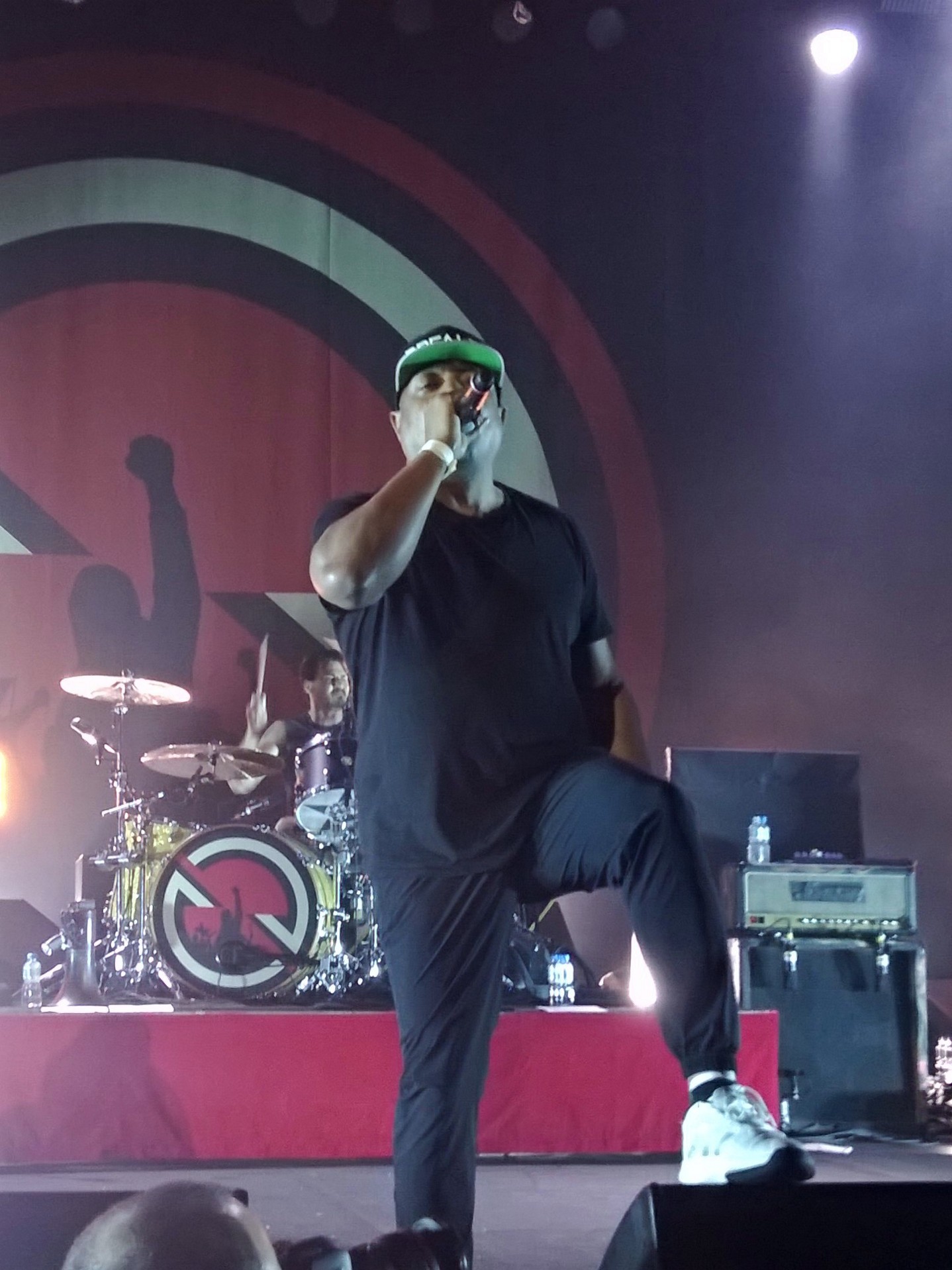
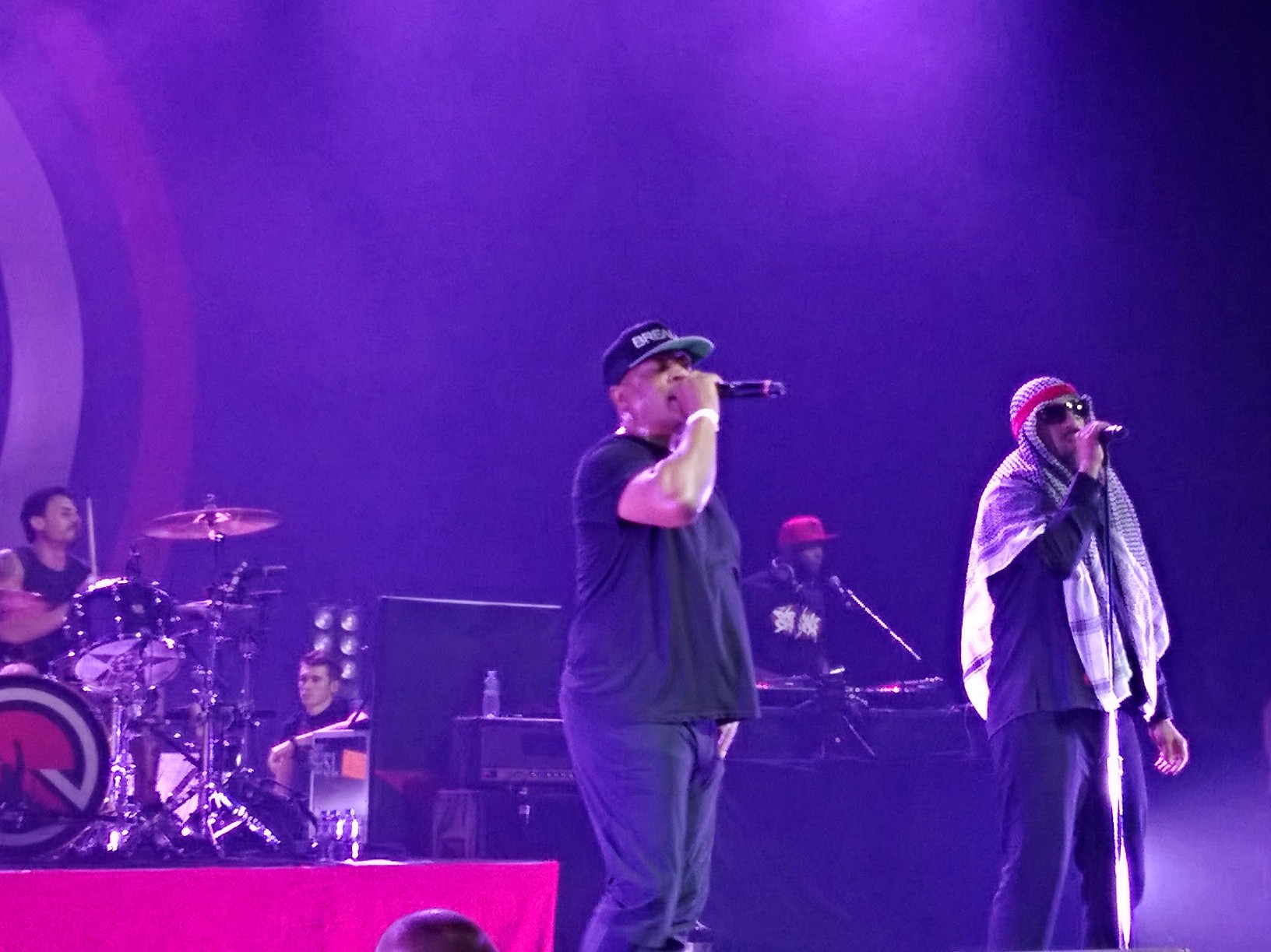
This was actually much more than a mere collaboration, it was a full blown band project with Chuck as second MC to B Real of Cypress Hill backed by Tom, Tim and Brad of Rage Against the Machine & Audioslave, as well as DJ Lord. They made an EP and an album and toured the world. Quite frankly, they were fucking amazing and it is still one of the best shows I have ever been to – they absolutely ripped it up in Rio and I had the privilege of being front and centre and shaking Chuck’s hand. Many thanks to DJ Lord for putting me on the guest list. Here’s a taste of what it was like.




 Hard Pressed